|
SEC Charges Private Fund Adviser Adit Ventures Management, its CEO and Affiliated General Partners in Alleged Fraud
The Securities and Exchange Commission today charged New York-based investment adviser Adit Ventures Management LLC, its CEO Eric Munson, and three affiliated general partners, Adit Ventures LLC; Adit Ventures II LLC; and Adit Ventures III LLC (the General Partners), for allegedly defrauding investors and client funds in connection with investments in pre-IPO shares, such as SpaceX and Klarna, including by misappropriating advisory client assets and charging millions in undisclosed fees.
According to the SEC’s complaint, from at least April 2019 through December 2024, the defendants used false claims and promises to persuade investors to contribute capital to Adit-managed funds, including Munson soliciting an investor by falsely claiming that a fund owned shares of stock of a private, pre-IPO company. As alleged, the defendants regularly used client capital for their own benefit, including by taking unsecured loans from funds on favorable terms, and these transactions were not authorized by fund documents and generally not disclosed to investors.
by SEC Litigation Release
|
|
👉 The SEC Complaint is here.
In addition to the Litigation Release above, the SEC also issued a rare case-related press release about this action.
In a statement, CEO Eric Munson went full "no admit," saying, “[l]et me be unequivocal: I have delivered for my investors, and I reject these allegations completely. I am settling this matter because fighting it will not result in any benefit for me or for the investors I have spent my professional life serving."
|
Netcapital charged by US SEC with fraud for allegedly inflating revenue
The U.S. Securities and Exchange Commission charged Netcapital with securities fraud on Monday over the fintech company's alleged scheme to overstate revenue.
The SEC said in a civil complaint filed in Boston federal court that Netcapital improperly recorded nearly $14 million in revenue from consulting agreements with John Fanning, a co-founder of the music sharing service Napster who created the Netcapital brand.
The SEC said the consulting agreements, including some that were forged, were shams that produced no real revenue for the Boston-based company and enabled Netcapital to more than quadruple reported revenue while it raised millions of dollars from investors.
by Reuters
|
|
|
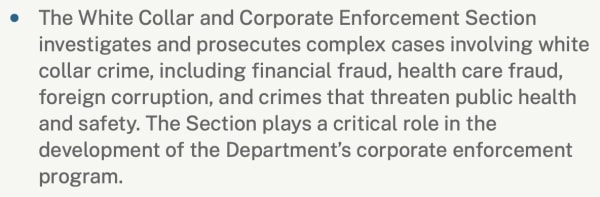
DOJ Renames Fraud Section Following White House Driven Shakeup
he Justice Department retitled its longstanding criminal fraud section as the “white collar and corporate enforcement section,” following a Trump administration shuffling as the White House prioritizes anti-fraud enforcement.
An update appeared on the DOJ Criminal Division’s website Monday displaying the change, and a department spokesperson confirmed the rebranding. The renamed unit will “align with its refined portfolio” with a focus on “private fraud enforcement” such as insider trading and securities fraud, the spokesperson said.
The change gives the white collar section a separate lane from the new National Fraud Enforcement Division’s mission of combating public benefits fraud and other schemes involving taxpayer dollars.
by Bloomberg Law
|
|
👉 A screenshot from the Criminal Division's website:
|
U.S. SEC sets meeting to propose Reg Crypto to support certain digital assets offerings
The U.S. Securities and Exchange Commission is about to propose its first formal rule that sets more durable rules for crypto businesses — in this case, a regimented path for legal issuance of digital assets under "Regulation Crypto."
SEC Chairman Paul Atkins has long set the goal of this rulemaking as one of the major points of his crypto regulatory plan, and the agency has schedeuled August 14 for the meeting at which the three-member commission (all Republicans) will open the SEC proposal for public comment. The regulator issued a Monday night notice announcing the Friday meeting with unusually short notice, though it's been on the agency's agenda for some time.
The start of Reg Crypto's approval process — said to involved "a tailored offering regime for certain investment contracts" — follows closely on the heels of last week's failure of the Senate to begin key votes on the Digital Asset Market Clarity Act that was meant to give a legal foundation for crypto market rules in the U.S.
by CoinDesk
|
|
|
Crypto bill faces long odds after Senate punts vote to September
With the bill facing continued opposition from key Democrats needed to clinch 60 votes, and the Senate logjammed with other business, Senate Majority Leader John Thune, a Republican, on Saturday pushed a procedural vote that could kickstart the process of advancing the bill to the Senate floor to September.
But many analysts and lobbyists are skeptical that it has a future. That's because the November elections, in which the House of Representatives and roughly a third of the Senate are up for reelection, will dominate lawmakers' attention and truncate Senate sessions during another busy stretch, leaving little time for lawmakers to resolve ongoing differences.
"I think it's a long shot," said Brian Gardner, chief Washington policy strategist at Stifel, adding lawmakers do not appear to be close to an agreement, particularly on contentious ethics provisions.
by Reuters: Business
|
|
|
More Securities Class Actions Are About AI. Is This Just Another Trend?
On July 29, Cornerstone Research reported that investors filed 15 AI-related securities class actions during the first half of 2026. If that filing speed holds, 2026 may see nearly double the number of AI-related securities class actions than 2025.
In the current environment in which businesses are exploring new AI capabilities, practitioners told Law.com they weren’t surprised about the increasing litigation.
But Brian Cochran, a partner at Robbins Geller Rudman & Dowd, wouldn’t call this a litigation surge just yet. He just isn't sure how big the wave could get.
“You can pretty safely assume there will be more … cases connected to AI, just exactly the nature and the magnitude is still unknown,” Cochran said. [...]
Cochran estimated that one-third of the cases his firm is thinking about have “some kind of significant AI angle.”
The cases that Cochran sees can be lumped into three buckets: so-called “AI-washing” cases in which plaintiffs argue that companies overstated their AI capabilities, disruption cases in which plaintiffs argue that companies concealed or misrepresented risks stemming from AI-related disruptions and then cases against companies that build AI software and hardware.
by law.com
|
|
👉 The Cornerstone report by Alexander “Sasha” Aganin and others is here.
Securities Enforcement Forum Central 2026 is set for Thursday, October 1, 2026 at the Ritz-Carlton Chicago! Join us in person or tune in virtually to hear from 35+ luminaries in the securities enforcement field—including numerous in-house counsel from major corporations, and lawyers and consultants from the best firms in the world.


